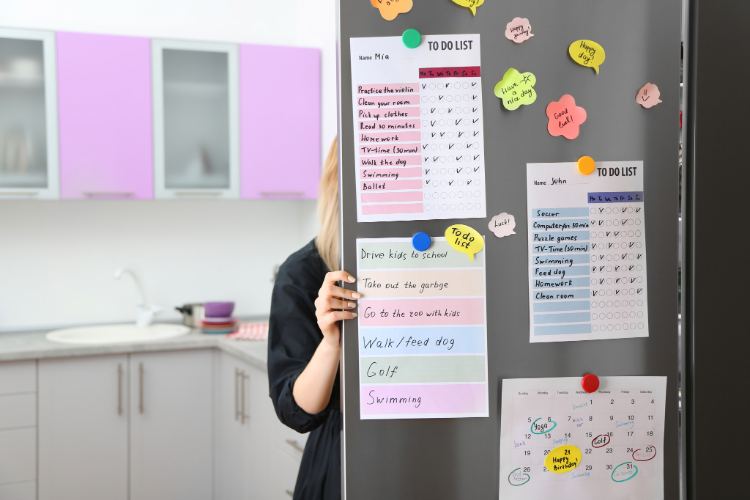
The 60-second answer: Most family calendar pain is not “we need prettier color blocks.” It’s handoff failure: the right information never reaches the right person at the right time, in the channel they actually use. Fix it with (1) a single source of truth, (2) named owners for pickups and admin, (3) recurrence + exceptions you maintain weekly, (4) delivery where people live (often messaging, not the calendar grid), and (5) a no-shame reset when the plan drifts.
| This guide fits if… | It won’t fix… |
| Two adults + kids, multiple schools/activities, constant handoffs | Deep conflict about who should carry mental load (that’s a conversation, not a feature) |
| You already have a shared calendar—but people still miss real life | A household that refuses any shared system whatsoever |
| Teens or partners check chat constantly but “forget” to open the calendar app | Compliance-grade scheduling for regulated workplaces (different problem) |
Why shared calendars feel like they should work—then don’t
Official statistics underline how much adult life is already spent inside household and childcare time budgets. In the U.S. Bureau of Labor Statistics’ American Time Use Survey, childcare and household coordination compete with work and sleep for the same finite hours—so small friction in “who knew what when” compounds fast. BLS ATUS Table 9: time spent caring for household children (primary activity), annual averages
Meanwhile, if you have teenagers, you’re not imagining the device reality: Pew Research Center’s recurring surveys on teens and technology show near-universal smartphone use and heavy engagement with major apps—useful context when a calendar invite silently dies in an inbox teens never open. Pew Research Center: Teens, Social Media and Technology 2024
The takeaway is blunt: a calendar only works if it wins the last mile—the reminder, the handoff, the confirmation.
Failure mode 1: Missed pickups and “I thought you had them”
What it looks like: Two adults, one kid, two interpretations. The calendar had the event, but nobody treated themselves as owner of execution.
Root cause: Events without drivers. A block labeled “soccer” is not the same as “Alex picks up at 5:10; Jordan brings snack.”
Stack fix:
- Owner field on handoff events (pickup/dropoff/medical/school admin).
- One push notification rule: if you’re the owner, you get the nudge; if not, you don’t get spammed.
- Backup clause for real life: “If owner is sick, text the group by 2pm.”
Failure mode 2: Duplicate events and conflicting “truths”
What it looks like: The same dentist appointment exists in three calendars with three times after time zones, manual edits, and forwarded invites.
Root cause: No version control culture. Everyone is authoritative; therefore nobody is.
Stack fix:
- Pick one master calendar (or one service) for household truth.
- Rule: edits happen in one place; other calendars subscribe, they don’t fork.
- Monthly hygiene: delete duplicates, fix time zones, reconcile school imports.
If tasks and time keep splitting across apps, consolidate intent on the page you’re already strengthening with redirects: best todo list app with tasks and calendar.
Failure mode 3: Teen silence—“I didn’t see it” (and they mean it)
What it looks like: The calendar is “shared,” but the teen never opens it. The plan exists; the attention doesn’t.
Root cause: Channel mismatch. You optimized for the adult who likes grids; the teen lives in messages and short bursts.
Stack fix:
- Short, timed nudges in the channel they already use (often a family messaging thread or DM pattern).
- One daily digest beats twelve micro-alerts.
- Clear ask (“Be ready at 7:40—bus early”) not a paragraph of context.
For school-heavy schedules, the student planner hub is a natural sibling page: best student planner apps for daily scheduling.
Failure mode 4: Beautiful grid, wrong reality (recurrence rot)
What it looks like: Recurring events drift: holidays, early dismissal, away games, a coach changes practice, and the calendar still “looks organized.”
Root cause: Calendars display confidence even when underlying rules are stale.
Stack fix:
- Weekly 10-minute reconciliation (Sunday night works for many families).
- Exception workflow (“this Tuesday only: late start”).
- One person accountable for imports (school portal, sports league) so updates don’t scatter.
If your week runs on blocks rather than loose tasks, pair calendar hygiene with time blocking: time blocking to improve productivity.
Failure mode 5: Notification hell—or notification nothing
What it looks like: Half the household turns off alerts because of noise; the other half gets nothing because permissions, focus modes, or multiple calendars mute the wrong events.
Root cause: Reminder strategy was never designed—only defaults.
Stack fix:
- Tiers: hard deadlines (medical, legal, money) vs soft nudges (optional chores).
- Quiet hours with an explicit exception path for true emergencies.
- One confirmation loop for anything new: “This is now on the calendar—correct?”
Deep dives on WhatsApp as the delivery layer (without abandoning calendar truth):
The stack that fixes them (simple, boring, effective)
Think in layers—not brands.
| Layer | Job to be done | What “good” looks like |
| Source of truth | One timeline everyone trusts | Duplicates rare; time zones correct; edits don’t fork |
| Ownership | No anonymous tasks | Pickups and admin have a name, not “someone” |
| Recurrence + exceptions | Real life changes weekly | School breaks and sports changes propagate |
| Delivery | Attention where it exists | Teens get short pings; adults get depth as needed |
| Review ritual | Prevent silent drift | 10–15 minutes/week; delete obsolete; fix conflicts |
Your family-calendar BOFU hub should remain the anchor readers hit from adjacent personas (students, habits, WhatsApp): family calendar apps.
For households where habits (meds, chores, sleep prep) are part of the same timeline—not a separate app universe—route to your consolidated habit hub: best habit tracking apps.
Where Fhynix maps onto this stack (product-led, not hype)
Fhynix is most aligned with families when the problem statement is execution, not decoration:
- Natural language capture (voice/text) so plans don’t die in chat scroll
- Calendar-first truth with WhatsApp-first delivery for people who won’t live inside a grid
- Confirmation so “we agreed” becomes visible, not assumed