The 60-second answer: The best family calendar is not the one with the most features. It is the one your household will actually use every day. If your family already coordinates in chat, choose a setup where calendar is the source of truth and reminders land in the channel people already check. If reminders are your bottleneck, prioritize reliable delivery over pretty interface.
| This guide is for you if… | This guide is not for you if… |
| You already tried one or two calendars but still miss pickups and deadlines | You want a heavy project-management suite for business teams |
| Your partner or kids resist installing and opening “one more app” | Your household already has near-perfect adoption with zero missed events |
| You care more about execution than fancy dashboards | You are only looking for a wall display device review |
Why families reject “another app” (and why they are usually right)
App fatigue is real. Even when people install many apps, attention is concentrated in a small number of daily habits. In family operations, this means one hard truth: if reminders depend on an app nobody opens, the plan fails even if the calendar is technically correct.
At the same time, household coordination load is not small. U.S. time-use data consistently shows meaningful daily time spent in childcare and household activities, so the handoff system has to be practical, not theoretical. U.S. Bureau of Labor Statistics, American Time Use Survey (Table 9)
And if teens are in the mix, channel behavior matters even more. Pew’s technology research shows near-universal smartphone use among teens, which is another signal that distribution channel matters as much as calendar structure. Pew Research Center, Teens, Social Media and Technology 2024
So yes—your instinct is correct: do not adopt a “better app” if it does not improve last-mile execution.
The scoring rubric that actually predicts success
Before looking at “best apps,” score any option on these five criteria:
- Reminder reliability: Do the right people get the right ping at the right time?
- Low-friction capture: Can you add events fast (voice/text/import), or is entry too slow?
- Ownership clarity: Can every pickup, payment, and admin task have a named owner?
- Conflict visibility: Can you see overlaps and resolve them before they break your day?
- Adoption reality: Will reluctant family members use it without constant nagging?
If an app scores high on features but low on adoption, it is not the best app for your family.
Honest shortlist: 4 family calendar stack types
Instead of a generic “Top 10,” use this shortlist by household behavior.
1) Native calendar stack (lowest change, medium reliability)
Best for: families already using built-in phone calendars with light complexity.
Works well when: two adults coordinate most logistics and kids are young.
Breaks when: tasks + reminders + school logistics spread across too many channels.
Verdict: good starter setup, but often weak for execution when schedules become dense.
2) Shared calendar + task app combo (high structure, medium adoption)
Best for: organized households who can maintain one task layer and one calendar layer.
Works well when: everyone accepts weekly planning and assignment hygiene.
Breaks when: nobody updates the task layer consistently.
Verdict: strong for planning quality, but can fail if your family resists process.
3) Calendar truth + chat-delivery layer (highest real-world execution)
Best for: families who already coordinate in WhatsApp and hate extra app switching.
Works well when: capture is quick (voice/text), then converted into scheduled items, then reminders return to chat.
Breaks when: there is no owner for events or no weekly cleanup routine.
Verdict: if reminders are the bottleneck, this is usually the highest-ROI model.
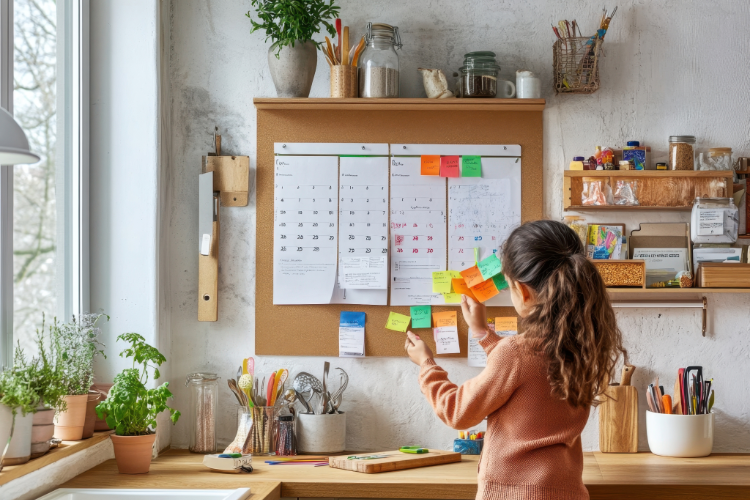
4) Command center display + mobile fallback (great visibility, weaker portability)
Best for: households that gather around one kitchen/home display.
Works well when: mornings are centralized and routines are predictable.
Breaks when: logistics happen outside home or shift daily.
Verdict: useful visual layer, but not enough alone for on-the-go execution.
If reminders are your bottleneck, follow this path
This is where most “best family calendar apps” articles stay vague. Here is the direct path:
- Keep one canonical calendar for events and ownership.
- Capture quickly (short text/voice) so commitments are not lost in chat scroll.
- Confirm what was scheduled in plain language.
- Deliver reminders in WhatsApp (or your family’s primary channel) instead of waiting for calendar-open behavior.
- Run a 10-minute weekly reset to fix recurrence drift and exceptions.
If you want practical examples of reminder copy and delivery patterns, link readers here:
Decision table: which setup should your family choose?
| Your situation | Recommended stack | Why |
| Small family, low schedule complexity | Native shared calendar | Minimal overhead and enough structure |
| Many tasks + deadlines but strong process discipline | Calendar + task combo | Better ownership and planning depth |
| People ignore calendar app but always check WhatsApp | Calendar truth + chat-delivery layer | Solves the last-mile reminder problem |
| Home-centered routine, one central wall/device | Display-first + mobile backup | Great visibility at home, weaker on-the-go |