
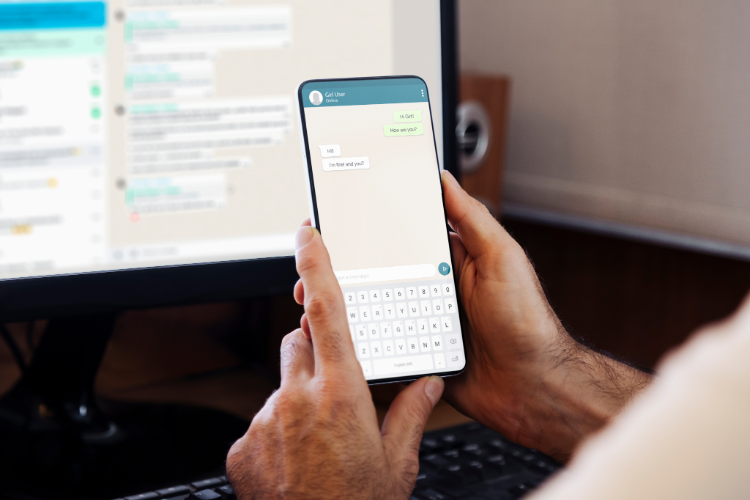
The 60-second answer: WhatsApp is a brilliant front door for coordination, but a weak system of record. A “real calendar” means one timeline for commitments (time, owner, recurrence, conflicts), with WhatsApp used for capture and delivery—not as the only place dates live. When chat becomes the calendar, plans scroll away, duplicate, and collide. The fix is structured capture (including voice) into scheduled items, then confirm what landed, then notify where people already are.
| This approach fits if… | It’s the wrong tool if… |
| Your household agrees in chat but still misses times | Everyone already lives in one shared calendar with perfect adoption |
| You dump plans via voice while driving or between tasks | You need enterprise resource scheduling across dozens of rooms |
| You want WhatsApp for input + nudges, not as the database | Any automated message is politically unacceptable in your group |
Why “we’ll just use the group chat” sounds rational—and quietly fails
Messaging apps are where modern coordination actually happens. Meta’s public reporting has highlighted WhatsApp’s scale—on the order of billions of monthly active users—which is exactly why families default to it: low friction, high reach, everyone already installed. Meta investor news, Q1 2025 results
The problem is not WhatsApp. The problem is using a linear feed to store time-based truth.
Research on interrupted knowledge work helps explain why chat-only planning feels mentally expensive: office studies have long documented how frequently people switch tasks and how interruptions reshape pace and stress—even when each interruption seems “small.” The underlying lesson for households is the same: every extra place you have to re-scan for “what’s true” is a tax. Microsoft Research: “The Cost of Interrupted Work” (Mark, Gudith, Klocke)
Your group chat is an interruption machine by design. That’s good for responsiveness—and terrible for being the only calendar.
Five WhatsApp failure modes (and what each one is really asking for)
1) The scroll-away commitment
What it looks like: Someone says “dentist Thursday 4” and everyone reacts with a thumbs-up. Three days later, nobody can find the message.
What it’s asking for: Immediate extraction from chat into a dated, timed artifact. The chat message can remain as context, but the commitment needs a stable home.
2) The ambiguous time zone / “ish” time
What it looks like: “Let’s leave around 5-ish.” Half the family interprets 5:00; half interprets “when I’m ready.”
What it’s asking for: A single canonical time with an owner (“Depart 5:10pm—Alex driving”). Precision reduces negotiation loops.
3) The duplicate-thread duplicate event
What it looks like: The same plan is discussed in the family group, the sports parents group, and a side DM. Each thread invents a slightly different version.
What it’s asking for: One source of truth plus a rule: “If it isn’t on the master timeline, it isn’t real.” Side chats can coordinate emotions; they shouldn’t coordinate clocks.
4) The recurring chore without recurrence logic
What it looks like: “Trash Tuesday” works until someone travels, holidays shift pickup, or a teenager’s schedule changes—and the reminder doesn’t.
What it’s asking for: Recurrence + exceptions, which is calendar semantics, not chat semantics.
5) The “someone should remember” task
What it looks like: A message ends with “can someone handle the permission slip?” Everyone assumes someone else did.
What it’s asking for: Named ownership on a task or event. A calendar entry without an owner is a wish, not a plan.
What counts as a “real calendar” (minimum viable definition)
You don’t need a complicated stack. You need these properties:
- Time-based items you can sort chronologically
- Recurrence for repeating life (school weeks, bills, sports seasons)
- Conflict visibility (two “must-do” items at the same time)
- Owners (who executes, not who was online)
- Reminders that fire from truth, not from whatever message was last
If you want a buyer’s lens on shared family scheduling—especially when multiple people refuse “another app”—start from the hub you’re consolidating authority into: family calendar apps.
The workflow: voice and chat in, structured schedule out
This is the bridge article between “we talk in WhatsApp” and “we execute on time.” The workflow should feel like three beats:
- Capture (fast, messy, human)
- Commit (structured, dated, owned)
- Confirm + deliver (so the household agrees what became true)
Capture: meet people where they already are
Capture should accept:
- A voice note while hands are busy
- A short text (“Add parent teacher Thursday 6:30”)
- A paste from an email or school portal
The goal of capture is zero formatting. The goal of the next step is 100% clarity.
Commit: natural language becomes real calendar objects
“Real calendar” means the system creates (or updates) items with enough structure to notify reliably:
- Title that matches how your family speaks
- Start time (and end time when it matters)
- Recurrence when it repeats
- Owner / assignee when it’s actionable
If your household’s pain is “tasks live in one app and time lives in another,” route readers to the unified-intent page you’re strengthening with redirects: best todo list app with tasks and calendar.
Confirm + deliver: WhatsApp as the confirmation layer
This is the anti-chaos step most “chat bots” skip. After capture, send a human-readable recap:
- What was created
- When it fires next
- Who owns it
- How to correct it in one message
Confirmation turns automation from “something happened in the background” into “we agree this is the plan.”
For readers who want the WhatsApp-specific mechanics and examples, these are the right internal deep dives (and match your existing BOFU URLs):
Migration playbook: from “chat is the plan” to “chat is the intake”
You don’t need a big bang. You need a house rule plus a 7-day habit.
House rule (one sentence):
“If it has a time, it gets captured into the master timeline—then WhatsApp can remind us.”
7-day habit:
- Pick one admin for the first week (reduces conflicting edits).
- End each evening with a 3-minute scan: anything time-based in chat gets extracted.
- Delete or pin obsolete chat plans so the thread doesn’t lie.
- Sunday reset: recurring items, school week changes, travel exceptions.
If your family thinks in “plans” more than “events,” daily planner semantics still need the same commitment mechanics: best daily planner apps.
Where Fhynix fits (without turning this into a brochure)
Fhynix is most convincing when it demonstrates execution, not categories:
- Voice/text in → parsed schedule items
- Calendar as source of truth → WhatsApp as the nudge layer
- One timeline for habits, tasks, and time blocks where that’s the product story
If time blocks are how your household survives overload, the consolidated time-blocking hub is here: time blocking to improve productivity.