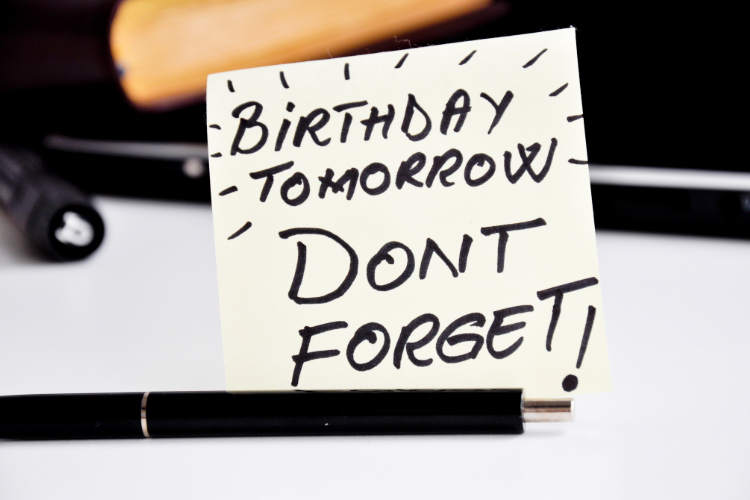
The 60-second answer: Late birthday texts rarely happen because you are careless. They happen because the day is emotionally salient but not operationally protected: no prep window, no gift lead time, and reminders that arrive in channels you swipe when busy. Fix it with a three-layer system—capture once, remind early, execute in a channel you actually open—and optional automation so the important people never depend on your 10pm memory.
| This guide fits if… | Skip it if… |
| You have sent (or almost sent) the “sorry, late!” message more than once | Your current system already never fails for inner-circle birthdays |
| You want a checklist + timing rules, not motivational fluff | You only need a single annual reminder for yourself |
| You are open to WhatsApp or calendar-first execution, not just another app list | You refuse to use any automation on principle |
Why birthday reminders fail (it is not a character flaw)
Birthdays look like “one date,” but they are a small project:
- Logistics: card, gift, delivery window, dinner plan, travel, time zones.
- Social risk: people remember how you made them feel more than the object-level gift.
- Notification reality: a single alert on the day is already too late for anything that ships.
Power users treat birthdays like operations: lead time beats last-minute heroics.
Primary CTA: If app banners get trained away, put must-not-slip social commitments where you already respond: reminder WhatsApp messages.
Layer 1: Capture rules (so nobody lives only in your head)
Use one durable source—calendar, contacts notes, or a single “people ops” list—and enforce minimum fields:
- Name + relationship tier (inner circle vs extended).
- Date + year handling (leap years, cultural calendars—pick one system and label it).
- Timezone default if people are distributed.
- Gift preference notes (sizes, allergies, “experiences not stuff”).
If you maintain multiple half-systems, you will miss someone. Consolidate ruthlessly.
Layer 2: The reminder ladder (never only “day-of”)
Replace one ping with a ladder scaled by tier:
| Tier | Who | Suggested ladder |
| A — inner circle | Partner, kids, best friends, key family | T-21 days (plan), T-7 days (buy/ship), T-2 days (wrap/message draft), day-of AM (send) |
| B — important but lighter | Close colleagues, wider family | T-7 days, T-1 day, day-of AM |
| C — acknowledge-only | Extended network | T-1 day + day-of; keep copy simple and kind |
The goal is not more nagging. It is moving decisions earlier so you are never shopping during a meeting.
Layer 3: Message design (warmth without cringe)
Late texts often sound guilty because they are rushed. Build a tiny template library:
- Day-of (on time): specific memory + appreciation + one concrete wish.
- If you are early: short excitement beats a novel.
- If something ships late: acknowledge the person first; separate the logistics (“your gift arrives Thursday”).
Avoid performative over-apology loops. People want sincerity and timing, not a speech.
Primary CTA: Automate the ladder for Tier A so execution does not depend on willpower: automated reminders on WhatsApp.
Copy-paste checklist: birthday ops without shame
- Confirm the date in your single source of truth.
- Pick tier (A/B/C) and apply the ladder.
- Set gift policy (budget cap, experience vs object, donation option).
- Shipping math: if it ships, T-14 minimum for most regions; international earlier.
- Calendar block for “buy/wrap/write” (30–45 minutes).
- Draft message the night before for Tier A.
- Day-of: send during their morning if time zones differ.
- Post-mortem: one note—“what to repeat / fix next year.”
Common failure modes (and the fix)
- “I remembered at night.” Move primary cue to morning two days before.
- “Facebook used to remind me.” Own the data; social platforms are not your CRM.
- “I hate generic texts.” Use ladders for prep; keep messages specific and short.
- “My partner handles gifts.” Split ownership explicitly—one owner per person, visible on the timeline.
Where Fhynix fits (social trust + execution)
Birthdays are a perfect wedge for “reminder quality matters” because the cost of failure is emotional, not administrative. Fhynix is relevant when:
- you want calendar-first truth with lead-time reminders,
- you need WhatsApp-class delivery for people who ignore planner apps,
- you want repeatable automation for the same ladder every year.
14-day proof test: pick three Tier A people. Run the full ladder. Track: on-time message, on-time gift arrival, stress level (honest 1–5). If stress drops without adding apps, the system is working.